Poems from me to We: harvesting Humanness


Nowadays I find myself living in two questions, both in my work and in my life: 1) What is hosting? and 2) How can we host from the rim of a circle?

I recently happened to join a group that was gathered in Ottawa to design a new conversation model that can engage all Canadians — in response to the divisive, polarizing attitudes that appear to be trending in the US and Europe. As we first came together, not knowing each other, we started with a check-in, putting in the center of the room the thoughts, stories, experiences that led us to be together in this place and at that time. The question that was asked was simple and powerful: what’s on your shoulders?

As people started to share, a collective story started to emerge, through the weaving of individual experiences: thus creating the soil for an experience of belonging that could lead to the collective work that needed to happen. Words were spoken that told stories of loss, violence, displacement, belonging, hope, reconciliation, grief, love, and agency. It was emotional, raw and beautiful, and you could feel in the room the importance of the moment. People stripped themselves of their layer of professionalism and competence, and showed up as humans who were invested in doing good work to create a better world.

In those moments, good harvesting is an act of love and service to the group. It can help a group amplify and make sense immediately of its collective voice beyond all these individual stories. There are many ways to do this. In Percolab, my colleague Paul uses his talent to create visuals that convey those stories and harvest those insights. Poetry can have the same powerful impact, and help host a group by staying present to all stories that are shared.

Listening for patterns is what informs us on who we are, and who we can be collectively. I tune my ear to the question that is asked. As the poem takes shape I become able to see associations, relationships that are forming between people who do not yet know each other. I can enter a space where I am in service of this collective that is emerging. The ego starts to dissolve, but the warrior for what is important comes into focus, at the same time as the collective story. There is no need to edit, just to listen and play: if this is to be a reflection of the humanness of this community it will be partial and imperfect. If it is in flow it will retain the islands of meaning and collective strengths within the complexity.

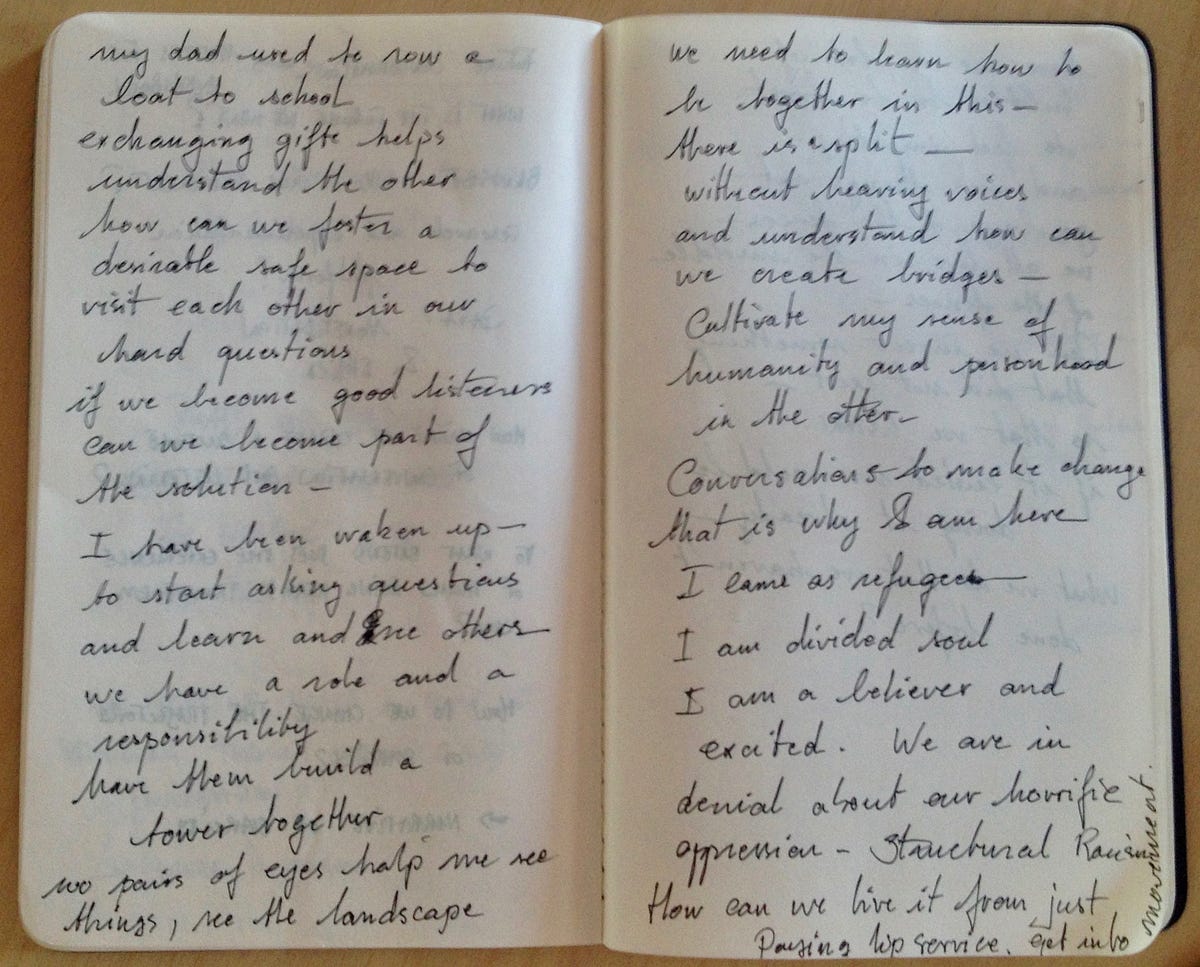
Here is an extract of what came out of this process:

on our shoulders

is our father’s boat

on our shoulders

are bridges and boats that are not build yet

on our shoulders

is the responsibility to be

better ancestors

and better descendants

on our shoulders

is our need to learn, care, connect

and tap into the wisdom

of doing without knowing

on our shoulders

are our lives of privileges

on our shoulders

are our lives of oppressing

and of being oppressed

and of being afraid

on our shoulders

is the need to celebrate and hold curiosity

fiercely

and with humility

learn to be with what is needed now

burst our bubbles

with kindness and humility

and grace

on our shoulders

are the curtains that have been pulled

from our eyes

and a world that is not what we thought it was

and the need to see

on our shoulders

is the need for a tower

to find the 100 pairs of eyes

that will help us see the world

What becomes important at that moment is that it is shared in the circle, as is, without filter. As a pure offering, a mirroring of what is there, giving an image of who we are through the woven words and stories that have been shared and put in the collective center. The poem in that moment is the first artefact of a commons held by the emerging community. Our role as hosts and space holders is to give « it », what wants to be born, a tangible shape, or form, be it through poems, visuals, or any other mean. It might be early, imperfect, a little dirty, a little raw, a little noisy, but it needs to be there in that moment for what it can then make space for: becoming a community anchored in something bigger than ourselves.

That early harvest is important work, as it can then be a difference between a group that stays focused on its purpose and a collective that falls in the trap of arguing about philosophical differences. What this experience helped me realize is how Hosting and Harvesting are really two sides of the same coin. If hosting is the art of creating and holding containers, harvesting is listening for the insights that help our groups make sense of their collective experience in those containers. My experience of slam as a harvest practice is one where poetry comes in service of a collective to help us surface our collective voice, make sense of the work we do and create more intentionality and presence to one another.
100in1day in Montreal: an economy of generosity

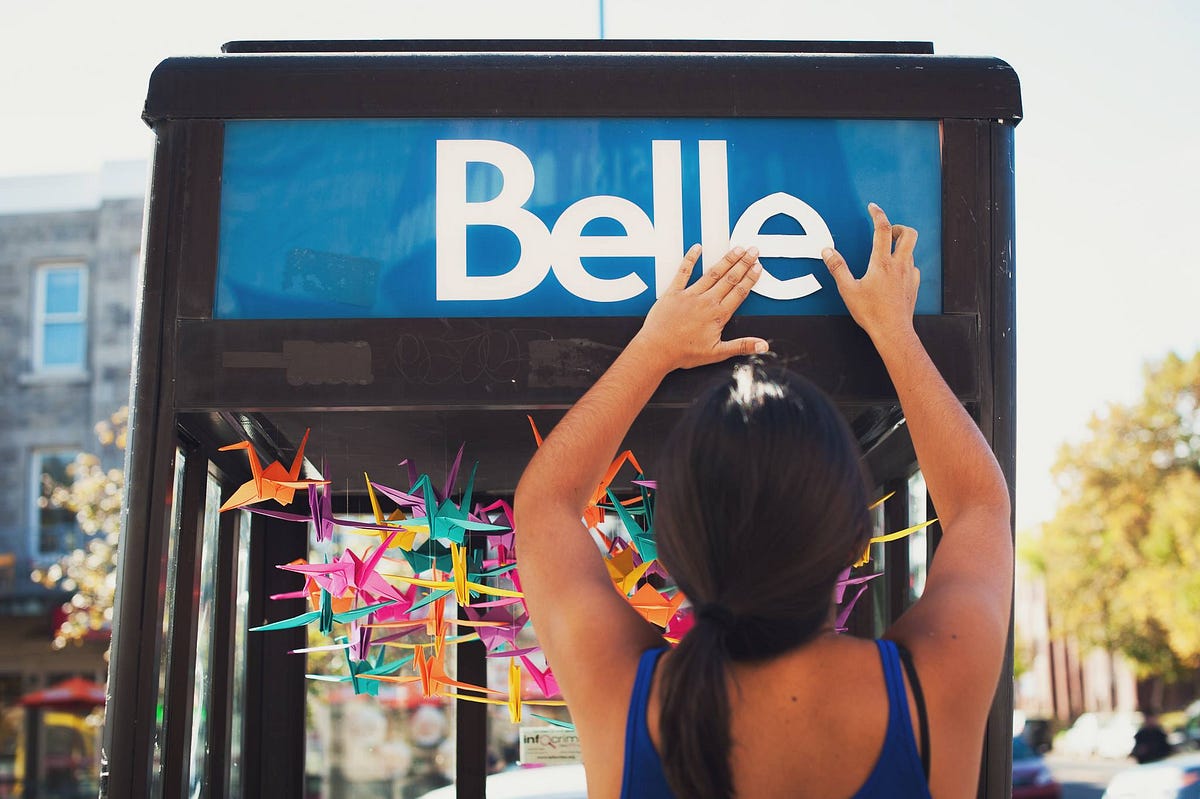
Photo By Alex Tran : http://alextranphotography.com/

At the end of may 2015, I was invited in Vancouver to take part to an artist roundtable, a wonderful event exploring the relationship between the arts and the new economy. Being invited came to me as a bit of a surprise, and I felt initially like an imposter there, being neither an artist nor an economist. Then I progressively understood that the gift was being in between practices and discourses, that I did not need to pretend to be someone I was not to be at my place there. What I could offer was my world, who i am, what I practice. And that would get me to talk about art, and it would also get me to talk about the economy.

What is the economy? And how do we relate to it? This is for me, and I would guess for a lot of us, far from an easy question. As I struggle to really grasp it, it still affects my daily life in ways that are mostly unconscious. Everywhere we human beings show up, we engage in big and small economic acts. The word Economy shares the same root as ecology. Eco, the home. Economy is the practice of managing the home. A practice, not a science, not a discourse. Something we do. A certain way in which we manage our home, whatever our home may be: household, block, community, planet. For the last few years of my life I have been yearning to find some agency in the way I manage the world as my home.

100in1day as practice for the new economy

I came to Vancouver to talk about a specific practice that I have been engaging with for the past couple years. I was involved in Montreal in the creation of an initiative called 100in1day, which aims, as I understand it now, to prototype a different way of « doing economy ». Different, but not necessarily all that new when you think about it.

The idea is simple: 100in1day stands for 100 actions by regular citizens, like you and me, to create in one day the city of our dreams. Why all the same day? So that all intervention leaders can feel the presence of all the other city lovers with them on that day, feel that they are not the lone nut wanting to give some love to their city. So that we can be a multitude, feel the power of the numbers. Where the rest of year we may feel alone in our desire to act, infuse meaning to the places where we live in, and live consciously on the stage of our daily life, that day we are together. And thus intervention leaders are free to infuse their city with a healthy dose of carnival. In this way, 100in1day, as an event, is a festival of doing, where we are authorized to test out ideas that we tend to keep to ourselves during the rest of the year. On that day we get them out and let them shine.

Our practice is based on a few very simple questions, or what ifs: what if we all worked together to create the city of our dreams? what if we took back the city as a commons, for one day? What would it look and feel like? What would happen there? Following these questions, 100in1day takes the shape of a prototype of a city that is made by its citizens. It also emerges as a practice, based on caring for the city as commons. I came to think about it as a practice of stewardship, where, through this moment we step in as citizens and re-learn to consciously inhabit the city, through 100 interventions that are as many gifts to the city and to ourselves, made in a spirit of celebration. The practice aims to change the story we tell ourselves about how we ought to live as citizens, and urban dwellers: how we show up in the commons. By getting us to show and share our gifts, getting involved in 100in1day essentially activates us to be more of ourselves wherever we are, be generous with who we are, be generous with each other. We simply practice being human.

All interventions that take place in the city are as many figures for a practice of active citizenship. These interventions start with the dream, and then follows an invitation to share it. An intervention is about daring to name the dream and act on it in a spirit of celebration and offer: inviting others to join in and open up to each other. In many ways, it is also reinfusing the idea of citizenship with a playfulness that may have been lost a little as we switched on our adult characters. It is, again, an invitation to be more of ourselves, through playing in the city, and daring to care. Will you be game?

I believe cities can be inspiring social spaces. I believe that cities are social beings, intelligent and creative. I believe in the incredible power of the Cité, as a collective entity made out of conscious individuals taking action on their own dreams while taking care of the whole. I believe that cities can be part of the solution to the challenges of our time and be generative spaces for life. 100in1day represents an embodiment of that vision, taking the form of a big invitation for others to come and play with it, in a spirit of generosity and celebration.

What did we aim to do, and did we do it?

We aimed to change a little story we as citizens tell ourselves about what is a city, and what kind of agency do we have to change it into something more inspiring, generous, connected and full of life? Where we are always collectively told that we cannot, that we do not know enough, that someone else is in charge, that someone else should do something about whatever is broken in our community, that there are not enough resources, that the government should step in, that the public workers will say no, that we do not have a right… We wanted to reconquer that story and explore how we can make it one of empowerment and agency. In this process we also understood that the subject of our inquiry was really the community, the city as web of relationships and group of human beings who decided to live on one territory. How do we practice our humanity together? How do we human (where human is a verb) in a world where the city is thriving, but the Cité is in danger and under threat? We believe that this work signals a potential paradigm shift, as it calls for a new way of being in the city and with each other.

Our goal is also to go beyond a one-day event, by turning it into an everyday practice of improvising in the city. Doing so would also mean turning away from the exceptional, the extraordinary, in order to reconquer the ordinary, the banal, the day-to-day interaction we have with the urban fabric, both physical and social. Through this shift we are beginning to see, we believe we are participating to the emergence of a new culture of engagement that we see sprouting up everywhere around us. 100in1day is another manifestation of this change that is pushing through, and as we connect with others we become conscious that it is about much more than « just » learning to play in the city: it is about reinventing ourselves, here and now, and learning to step into our power to be complete human beings, inhabiting the city and the planet consciously.

1ooin1day and the new old economy

When discussing what was shaping up at the center of our interactions, we would often refer to what was going on as a prototype for an « economy of generosity ». To be honest, I am still unsure about what this fully means today. What I understand is that we operate from a posture of care, one where we feel we may be guarding something sacred that we as a civilization may have strayed from over the last few centuries. Thus we do not consider what we are doing as anything new, but more as an attempt to come back to our roots as human beings, earthlings: taking care of the place we inhabit, and of each other. The root of economy. We think of it as stewardship, and that the core question of the practice of active citizenship is inherently tied to this: how do we shift from being occasional actors to being stewards in the city? This, to us, draws the outline of a new economy that is grounded in something ancient and sacred: a practice of commoning. Reclaiming what is ours, and through that process prototype the new city created with people, for people.

The hundred or so interventions act as catalysts: if I acted once, I can act again. A hundred interventions aim to lit as many fires in our hearts, to do more, crave more, and transform the way we live in the city and act together. We aim to lit hundreds of smaller fires, every where, and all the time. We want to be the keepers of that fire, because it is sacred and precious and beautiful. That fire will be the center of the new household we will manage together, with generosity and courage. It is burning in me. Is it burning in you?