What is the art of social innovation?

Photo by Michael Fenton on Unsplash

The fundamental purpose of social innovation should be to bring more beauty, peace and justice to the world. Its practices call for the capacity to listen and learn from shifting contexts and social landscape, and to co-design with others solutions to the issues that affect our communities. It takes into account existing and future relationships, notions of place and sovereignty, and requires a keen understanding of complexity and emerging ways to work with an eco-system mindset.

Social innovation is social because it rests on an explicit theory of social development and is rooted in the idea of progress: making society « function » better for everyone. First and foremost, it is social because it involves people. It calls for engaging people in the enhancement of their quality of life and figuring things out together. It is social because it involves an ability to work with a wide diversity of perspectives, levels and experiences, and to listen and act from a strong ethics of service and care. This requires curiosity, honesty and humility. It is social because it suggests a capacity to hold tensions and paradoxes that are at the heart of every human collective and get the work done because (and not in spite) of that.

Social Innovation is also social because it is anchored and embedded in places and territories and communities. Social innovations are tightly linked to the contexts from which they originate. They answer needs and reflect aspirations in communities. They foster a sense of belonging. Moreover, the very nature of the territory on which they emerge here (Canada) adds another layer of complexity to this : there is an intimate link between social innovation and the question of reconciliation, which may be the single most important social and ethical question that we have to learn to be in as Canadians in this century and in this place. If, as I believe, there is no social innovation outside of place, then in turn it means that a movement for social innovation needs to name and acknowledge its relationship to colonial power and the erasure of First Nations presence on the territory. The real work of social innovation is decolonization. It is un-settling in its core.

The word innovation suggests the idea of the new. However, social innovation is not so much about a new « thing » as much as it is about a capacity to see a social context with new eyes and perspectives. It means working from an understanding that reality is not fixed, that problems and contexts evolve and that the innovation truly lies in our ability to see the future as it takes shape, and move with it. Social innovation calls for an increased capacity to take in the complexity of the systems we live in, and shift the unhealthy patterns that create them and are created by them.

When put together, the social and the innovation parts help us broaden our understanding of our reality and the possibilities that it harbours. At the heart of this is the notion of the ecosystem, and of ecosystemic capacity building: the capacity to see beyond self and organization and present relationships, towards something that is much more fluid, dynamic, diverse and connected to life. Social innovation expands the sense of possibilities that are available to us, and shows us what we as humans can do together when we put our minds, hearts and wills in service of a purpose bigger than ourselves. Social innovation involves learning to be in our full capacity as humans, which I consider to be the most pressant need we have if we are to collectively tackle the urgent social, ecological and ethical challenges of our time. Only then will we become the collective force for the regeneration of planetary ecosystems that we can be.


Right, left, straight ahead, back up.


5 questions to navigate the choices life throws us

Une version française de cet article est disponible ici.

A few months ago, I was sitting at a restaurant table across from three gentlemen I have the pleasure to work with, and for whom I have a tremendous amount of respect. Above the remains of an excellent meal, the conversation gently veered towards the principles we hold that preside to our choices. Each of these choices we take, wether as individuals or as communities, are grounded in assumptions and principles. Often these principles remain implicit and unconscious. But what becomes possible for us when our choices are powered by conscious, explicit principles?

Eight weeks ago, I left the vehicle that I thought was my working anchor: Percolab. For the last few years it has been my lighthouse and my home — the place that grounded my identity as a professional and practitioner. It was my learning and belonging ground, and I was blessed to be building it with a group of fellow human beings with whom it seemed to me that nothing was impossible. No obstacle could not be overturned. No conversation was off-bound. I had found my Home, and I had gained superpowers.

Still, after all these years where Percolab was to me a beacon of stability, a few weeks ago I felt a sense of exhaustion gradually take me over. I was tired. Blocked. Incapable of moving forward. I understood that the collective was moving in a direction that was not mine, and I felt out of breath. Percolab was scaling, developing, getting out of its shell, and it was beautiful to see. I needed connection, learning, depth. I needed to breathe, and slow down to a rhythm that would allow me to breathe and grow again. It is when I understood that, that I decided to leave, and change directions. A point of bifurcation presented itself. A choice was made. But what was behind this choice?

This is where I am coming back to this notion of principles, whether they appear in the projects we lead or in other spheres of our lives. What is it that leads us to choose a direction over another, to accept or decline projects? Months ago, this was the heart of the conversation around the small restaurant table. And I remember that to this simple question: « what is it that leads to accept or decline work? » one of us had answered that the question for him was to know whether that project was going to help him become a better person. These few words, to me, felt like someone had hit a gong bell.

I stayed with this answer. And I took it as my own. I then understood that, for me too, this had been a leading principle in my life and work choices. And now this was explicit. The work I had done, and the work I was going to do, had to help me become a better person. And today I want to explore what my other principles are. Without surprise, it is a list of questions. A living list, bound to expand and change over time, only because clarity is not so much a result as it is a process of infinite unveiling.

1. Does this project help me become a better person?

We are all engaged in a process of humaning — becoming human beings. And f I want to participate in the emergence of a more desirable future for all, it begins with transforming myself. It begins with recognizing the powers that I hold and those that I have inherited. I have a privilege, a voice, a status that I did not earn. I know how to navigate the dominant culture, because I look like it, because it was created by people like me. I want to participate in a fairer, more equitable world, a world where each human being can be seen, heard, honored, and can rise to its potential. It begins with seeing and recognizing my own relationship with power, privilege, voice. I want and I call for work and projects that help me learn about myself, about others, and where I can grow into a more powerful, a better version of myself.

2. Does this project add more beauty to our world?

Cultivating beauty, to me, means holding the line between what is and what what we want to see, and be. Beauty is in congruency. Some people like to speak about alignment. Care and inquiry are my weapons to touch this congruency. I want to invest my energy in spaces that will enable me to sharpen those weapons, projects that are explicit about cultivating for this kind of beauty in our world.

3. Does this project instill a bit of fear in me?

If yes, that is a good sign. I want to work in projects to push me towards my edge. I know that where there is that trembling, that fear, that is also where learning is. We tremble because we touch a limit, a potential that is not yet manifested or named. I am calling for projects that get me to touch that untapped power, that give me the space to uncover it by jumping into the unknown.

4. Will this project leave the world in a better shape than when it started?

I want to help those who do good work, by taking of themselves and others. I want to help those who want to do good work through working better. I listen. I inquire. I reframe. With kindness and openness. And together we become able to uncover the darker patterns, the shadow sides, what is outside the frame and what limits us. Together we develop our capacity to see the rocky parts where our good intentions get stranded. Together we learn to practice from our unknowing to wider the range of what we know.

5. Will this project help us make wiser choices, collectively?

I want to be in co-learning with others of my full capacity as a human being, with all my strengths and my vulnerabilities. This means that I want to learn how we can be together in spaces where we get to explore our gifts, and where those gifts are wanted and called. I want to support the emergence of a new culture of being, thinking and doing together. We need to learn how to see and listen to this new culture. We need to learn how to rediscover it. We have learned to hide it to our senses. We can learn to express it again through new and old practices of listening and caring: caring for others, and listening for what life is calling from us. Only then will we become able to make wiser choices and fully participate to the well-being of what my 7-year old Rachel calls, in her infinite wisdom: “the kingdom of Life”.

What if we learned

together

the art of humaning

to better see one another

and know one another and

help each other

fulfill our full potential

in service of Life?

What about you? What are some of your big and small principles to choose where your steps will lead you?

À droite, à gauche, en arrière, tout droit

Photo by Andrew Neel on Unsplash

Cinq questions pour choisir le cours à prendre

An English version of this article can be found here.

Il y a quelques mois, j’étais ici assis autour d’une table à Montréal, avec trois amis avec qui j’ai le plaisir de travailler et pour qui j’éprouve un immense respect. Au-dessus des quelques restes d’un excellent repas, la conversation nous a mené à la question des principes que nous tenons, qui nous amènent à prendre les décisions que nous prenons. Chacun des choix que nous faisons, en tant qu’individus ou en tant que groupe, est conditionné par des principes. Souvent, ces principes restent implicites, inconscients. Qu’est-ce qui devient possible pour nous quand ces choix sont propulsés par des principes explicites, conscients?

Voilà huit semaines que j’ai quitté le véhicule que je pensais être ma maison de travail, Percolab. Depuis les dernières années, c’était l’ancrage de mon identité de professionnel. C’était mon terrain d’apprentissage et d’appartenance, que j’allais construire avec un groupe d’êtres humains avec les quels je croyais fermement que rien n’était impossible, aucun obstacle incontournable, aucune conversation inaccessible. J’avais trouvé mon ancrage: « Home ». J’avais l’impression d’être surpuissant.

Et pourtant, après toutes ces années où Percolab m’est apparu comme un bastion de stabilité, il y a quelques semaines je me suis découvert fatigué. Incapable d’avancer. Frustré. Bloqué. J’ai compris que l’organisation avançait dans une direction qui n’était pas la mienne, et que ça créait en moi un essoufflement. Percolab faisait le choix de se développer, de se déployer et c’est quelque chose de magnifique et nécessaire. Mais c’était aussi un moment où j’avais besoin de profondeur, d’apprentissage, de connection. J’avais besoin de ralentir, et d’un rythme qui me permette de souffler. J’ai donc pris la décision à ce moment-là de changer de cap, et de quitter. C’est un point de bifurcation qui s’est présenté, et un choix a été fait. Mais qu’est-ce qu’il y a derrière ce choix?

C’est ça qui me ramène à cette histoire de principes, particulièrement dans les projets que nous faisons, mais c’est valable dans toutes nos vies. Qu’est-ce qui nous pousse à prendre telle ou telle direction, à accepter ou refuser des projets? Il y a des mois de ça, c’était le coeur de la conversation autour de la petite table du restaurant. Et je me souviens aujourd’hui qu’à cette question simple: « qu’est ce qui nous amène à accepter un projet plus qu’un autre? », l’un de nous avait répondu que la question pour lui était de savoir si ce projet allait faire de lui une meilleure personne. Ses quelques mots m’ont fait l’effet d’un coup de gong.

Je suis resté avec cette réponse. Et je l’ai reprise à mon compte. J’ai compris que pour moi aussi, ça avait été un principe directeur de mes choix de vie et de travail. Là où ce moment a fait une différence pour moi, c’est que j’ai compris qu’à compter de cet instant, c’était devenu un principe explicite. J’allais faire du travail qui ferait de moi une meilleure personne.

Et aujourd’hui je veux explorer quels sont mes autres principes. Sans surprise, c’est une liste de questions. Et c’est une liste vivante, c’est dire qu’elle est vouée à s’enrichir avec le temps: parce qu’en effet, la clarté qui se fait n’est pas tant un résultat qu’un processus de dévoilement infini.

  1. Est ce que ce projet fait de moi une meilleure personne?

Nous sommes tous des êtres humains en devenir. Et si je veux participer à la transformation du monde qui m’entoure, ça commence par moi-même. Par reconnaître les pouvoirs que je tiens et ceux que j’hérite. J’ai un privilège, une voix, un statut. Je sais naviguer la culture dominante, parce que je lui ressemble, parce que des gens comme moi l’ont créée. Je veux participer à un monde plus juste, un monde où chaque être humain pour être vu, entendu honoré, et élevé à la hauteur de son potentiel. Ça commence par voir et reconnaître mon propre rapport au pouvoir, au privilège, à la parole. Je veux et j’appelle donc des projets où je peux apprendre sur moi-même, sur les autres, où je développe mon pouvoir d’être une version plus puissante, meilleure de moi-même.

2. Est-ce que ce projet ajoute de la beauté dans le monde?

Cultiver la beauté autour de moi, c’est tenir la ligne entre ce qui est et ce qu’on voudrait voir, et être. Je définis la beauté en termes de cohérence. Certains parlent d’alignement. Le soin et le questionnement sont mes armes pour toucher cette cohérence. Je veux mettre mon énergie dans des espaces qui me permettront d’affûter ces armes, des projets qui recherchent explicitement cette forme de beauté.

3. Est-ce que ce projet me donne un peu la trouille?

Je veux des projets et des espaces qui me poussent vers ce qui me fait peur, vers ce qui me fait trembler. Parce que j’ai le sentiment que là où le tremblement est, c’est là qu’on trouve l’apprentissage. On tremble parce qu’on touche à la limite, à un possible qui n’est pas encore nommé. Je veux des projets qui me font toucher à cette possibilité de développer mon pouvoir, qui me donnent l’espace et me demandent de le faire en sautant dans l’inconnu.

4. Est-ce que ce projet va laisser le monde dans un meilleur état qu’il l’a trouvé?

Je veux aider ceux qui veulent faire du bon travail, en prenant soin d’eux-mêmes et des autres. Je veux aider ceux qui veulent faire du bon travail, en travaillant mieux. J’écoute. Je questionne, avec bienveillance et ouverture. Et ensemble, nous devenons capables de dévoiler les zones obscures, les ombres, les hors-pistes. Ensemble nous développons notre capacité à voir les récifs où les bonnes intentions échouent. Ensemble nous apprenons à pratiquer à partir de ce que l’on ne sait pas pour augmenter ce que l’on sait.

5. Est-ce que ce projet nous aidera collectivement à apprendre à faire de meilleurs choix?

Je veux être en co-apprentissage de ma capacité pleine d’être humain, avec toutes mes forces et mes vulnérabilités, en relation avec d’autres humains. Ça veut dire apprendre à être ensemble dans des organisations qui sont des espaces pour explorer nos dons, et surtout où ces dons sont voulus et appelés. Je veux soutenir l’émergence d’une nouvelle culture du vivre, penser et faire ensemble. Cette nouvelle culture, il faut savoir l’écouter et la voir. La dévoiler. Elle ne se laisse pas apprivoiser facilement. On a appris à se la cacher. Cette culture nouvelle, elle s’exprime à travers des pratiques d’écoute et de soin: soin des autres, et écoute de ce que la vie appelle. C’est seulement là que nous deviendrons capables de meilleurs choix collectifs, et de pleinement participer au bien-être de ce que Rachel (7 ans) appelle dans son infinie sagesse: “le royaume du vivant”.

Et si on apprenait

ensemble

l’art de devenir humains

pour mieux nous voir et

nous connaître et

nous aider les uns et les autres

à réaliser

notre plein potentiel

au service du vivant?

Et vous, quels sont vos petits et grands principes pour choisir le cours de vos pas?

Aimer sans nommer — une méditation

Photo by Martin Sattler on Unsplash

D’après David Whyte, 2015 — “NAMING” In CONSOLATIONS: The Solace, Nourishment and Underlying Meaning of Everyday Words.

aimer

est une expérience humaine

merveilleuse et poignante

une trajectoire

dans la vulnérabilité

mettre un pied

dans un espace

où les choses

ne se ressemblent pas

et où le vrai se transforme

et où les mots se réinventent

et où le moi

et où le nous

grandit


je me découvre

je m’apprend

je me dévoile

je me mets à nu

à vouloir nommer

qui j’aime

ce que j’aime

pourquoi j’aime

comment j’aime

je me blesse

je m’écorche

je m’essaie

toujours trop tôt


est-ce que je peux voir

au commencement

quand je me donne

la rivière qui nous rejoint?

et comment elle se transformera?

et quelle est sa vraie profondeur

quand je m’y trempe les orteils?

et quelle est la force du courant

qui m’entraîne

vers l’autre

et vers moi

vers mon devenir

avec l’autre?


quand je nomme

ma réciprocité

quand je nomme

ma transparence

quand je nomme

ce que sont mes ancrages

quand je nomme

où sont mes murs

quand je nomme

mes sables mouvants

quand je nomme

les recoins

où se cachent les fantômes

qui me gardent éveillé

je sais aussi

que l’amour ne s’est pas encore dévoilé

que je prends une chance

avant que la fleur soit prête

et je sais aussi

que la fleur connaît le cycle du temps

elle s’ouvre le jour

et se referme la nuit

elle s’étend quand l’air est humide

et se protège quand il s’assèche

je ne sais jamais complètement

où je me trouve

dans quelle eau

et dans quelle vie


et quand la rencontre

n’a pas lieu

ou quand je sors de la rivière

blessé et fatigué

et replongé

dans les questions

je connais le deuil

et la déception

et le repli en moi-même


et perdu dans le manque

je perds de vue

ce qui est présent

ce qui est possible

dans l’espace que nous créons

ensemble

en vivant

et perdu dans le manque

je me retiens à

un objet

que j’attends

mais qui n’est pas là

et n’a jamais été là

et perdu dans le manque

je confonds la carte

et le territoire

le lit de la rivière

et la rivière

et perdu dans le manque

je perds de vue

le possible

qui ne ressemble pas à

ce que je croyais attendre

et perdu dans le manque

je me retire dans l’égo

où je me sens

laissé pour compte

sur le côté

déçu et trompé


mais ce qu’on aime dans la fleur

c’est la vie


et l’absence est

une l’invitation

à aller plus loin

toujours plus loin

et plus profond

vers l’inconnu

vers le vrai

à la limite du connaissable

une nouvelle forme

d’affection

à recréer

encore

et encore

une invitation vertigineuse

et aveugle

et courageuse

et l’absence est

une invitation

la seule vraie invitation


je veux apprendre à créer

cet espace partagé

et vivant

un espace rivière

un espace mouvement

la rivière n’a pas de forme

elle est le mouvement

et c’est d’être dans le mouvement

que je veux apprendre

pas de voir le lit de la rivière

mais la rivière elle-même

j’apprends à aimer

le territoire


aimer est un verbe

d’action

aimer est apprendre

dans une pratique

d’humilité

seulement dans l’humilité

je peux reconnaître

ses incarnations


et j’ai confiance

et j’apprends à être confiant

parce qu’aimer m’apprend

à pratiquer la confiance

en m’apprenant à regarder

à chercher

la beauté et la vérité

dans les recoins inattendus

tout autour de moi

et en détachant mes yeux

de la carte que le monde m’a donnée

pour lire ma vie

sans savoir

pourquoi

quand

et comment

et sous quelle forme

ce que je donne

me sera retourné

enveloppé de mystère


nous voulons nommer l’amour

mais ce qui vaut la peine

de vivre

et d’aimer

ne tient pas dans

les petites boîtes

que nous prépare la vie

ce qui vaut la peine d’aimer

n’a pas de nom


nous voulons nommer l’amour

mais c’est l’amour qui nous nomme

nous voulons appeler l’amour

mais c’est l’amour qui nous appelle

et qui nous parle

et qui nous fait bouger

avant même

qu’on le voie

avant même

qu’on sente sa présence

nous voulons comprendre l’amour

mais c’est l’amour qui nous comprend

avant que nous viennent

les mots justes

pour décrire

le monde qui se forme

sous le mouvement

de ses couleurs


une invitation

courageuse

à l’art d’aimer

sans nommer

Ce que j’ai traversé

Photo by Lukas Becker on Unsplash

Le 24 et 25 janvier 2018, l’équipe de Percolab était à Victoriaville pour la tenue du premier rassemblement de Culture Québec, l’ensemble des Conseils Régionaux de la Culture au Québec. Une cinquantaine de représentants de toutes les régions du Québec étaient réunis en cercle, pour deux jours de partage et de connexion, et pour la première fois en quarante ans d’existence.

Le premier jour, pour ouvrir la rencontre, nous avons déposé au centre du cercle une roche de parole, accompagnée d’une simple question: “qu’avez-vous traversé pour être ici aujourd’hui?” Une à une, les personnes présentes ont tenu la roche dans leur main et partagé leur réponse.

Ce texte est tissé directement à partir des mots qui ont été prononcés alors que les mains touchaient la pierre. Il est l’expression de la voix collective qui s’est dévoilée durant ce moment. C’est sous cette forme qu’il a été partagé à tous, une fois que la dernière participante s’était exprimée.

Ce que j’ai traversé

pour arriver ici

aujourd’hui

j’ai traversé les années

le temps vécu

et ressenti

sorti de mon jardin

pour voir ce qu’il y a de l’autre côté

j’ai rencontré l’autre

j’ai traversé des marées de questions

des forêts et des branches

pour trouver mon carrefour

j’ai traversé et

j’ai appris à dire non

et j’ai appris à dire oui

pour être ici à plusieurs

j’ai dit oui à être ici

j’ai traversé le doute

et le temps qui file

pour me donner un cadeau

à moi-même

j’ai traversé le Québec

pour atterrir chez moi

Photo by Ivan Levchenko on Unsplash

j’ai traversé la tempête

pour être ici dans la beauté

avec mes gens

et avec vous

j’ai traversé l’incroyable

et propulsé par nos rencontres

et par l’espoir

j’ai traversé la bulle

de ma voisine

appris l’extraordinaire

j’ai traversé la province

et partagé

mes plusieurs chapeaux de vie

j’ai traversé le vieux Saguenay

et la nouveauté

à ma place

j’ai construit

ma traversée

de plusieurs mois

Photo by Nitish Meena on Unsplash

j’ai traversé des rivières de questions

et des territoires d’eau

et des partages et des rencontres

pour le plaisir d’être un océan

et adoptée d’un autre côté

Ontario

péage

et une bulle de plusieurs vies ensemble

j’ai traversé un fond de culotte

entre rires et connexions

j’ai traversé un corps engourdi

je me suis étiré

dans les rencontres et les années

j’ai tiré les absents

et invité

des attaques de baisers

à la craque du jour

j’ai traversé

la danse d’être ensemble

faire ensemble

créer ensemble

Photo by Gauravdeep Singh Bansal on Unsplash

j’ai traversé

un mur de fer

pour courir

et résister

venir ici

faire l’histoire du nous

et l’espoir des échanges

j’ai trouvé

une terre d’adoption

de vent

de rivière

pour être où je suis

et fière d’où je suis

traversé pour ouvrir

et découvrir

traversé les Laurentides

pour trouver mon ancrage

et mes gens

j’ai lâché prise

sur l’atlantique

traversé en plusieurs années

et petits sauts

j’ai traversé ma vie sur des roches

j’ai traversé une vie de sauts

au bord du fleuve

et la naissance des agneaux

j’ai attendu de pouvoir

être là

Photo by Aperture Vintage on Unsplash

j’ai traversé le temps

en gratitude

pour être en possibilité

ici et maintenant

j’ai traversé les années

et les jours qui se multiplient

intenses et

patients et

présents

j’ai traversé des régions

j’ai embarqué mes paysages

et je me suis laissée accueillir

un matin sans tempête

pour arriver

j’ai traversé des questions

cherché l’autre

et un second souffle d’énergie

pour créer notre départ

et vivre bien

quatre familles tenues

pour sortir de mon confort

et prendre la route

ensemble.

L’Art de devenir humains

Visuel Chloe Waretini

prendre un pas de recul

et écouter

ce qui vibre

prendre un pas de recul pour écouter

les murmures


peux-tu ralentir

ton pas

et voir

ce que la Vie me murmure

ce que la Vie te murmure

ce qui est appelé

à naître?


je prends un pas de recul

pour écouter les voix

au coeur du bruit

j’entends l’écho de quelque chose d’ancien et vrai

je vis dans la turbulence

je respire l’émergence

peut-on apprendre à y rester

de tout notre être

et consciemment

et dans la générosité

et la grâce

la reconnaître

et s’y épanouir

pour devenir?

pouvons-nous apprendre

à nous accueillir

dans notre capacité à devenir

de meilleurs humains?

pouvons-nous y découvrir

notre muscle commun

et le mettre au service

de tout ce qui est vivant

tout ce qui l’a été

et tout ce qui le sera?

pouvons-nous y apprendre

et nous pratiquer

à devenir de meilleurs ancêtres?

pouvons-nous y apprendre à nommer

la complexité

ici et maintenant

et à affûter nos armes faites d’amour?


j’appelle l’Art de devenir Humains

parce que nous ne pourrons pas

nous transformer

en restant où nous sommes

en restant qui nous sommes

collés au déjà connu

collés au prévisible

collés aux vérités parcellaires

collés à nos pensées linéaires

je veux apprendre à tenir

le mouvement dans l’immobile

je veux apprendre à voir

le tout dans les fragments


pouvons-nous apprendre

l’art subtil d’écouter

pour la sagesse

qui nous guide vers ce qui a besoin d’être?

pouvons-nous devenir

dans la conscience

des systèmes

de pouvoir

qui nous forment et qui

dessinent les espaces

où nous respirons

où nous sentons

où nous trouvons ce qui nous nourrit

et ce qui nous blesse?

pouvons-nous apprendre et pratiquer ensemble

voir et nommer

nos ennemis?

et avec toute notre force ancrée

nous lancer vers l’action?


j’appelle l’Art de devenir Humains

j’appelle notre pouvoir

de travailler au-delà

de nos égos

de découvrir notre futur commun

de co-créer

de reconstruire

de découvrir

ce que nous pouvons faire

ensemble

j’appelle

un futur

où nous sentons ensemble

et pratiquons la grâce

en appelant

ce que nous ne pouvons pas encore imaginer


qu’est-ce qui devient possible

quand nous mettons en commun

nos pouvoirs d’êtres humains sensibles

au service du passage

vers la conscience de notre éco-système?

que pouvons-nous apprendre

de ce que nous sentons ensemble?

que pouvons-nous transformer

quand nous découvrons

et avançons

dans notre plein pouvoir collectif?


j’appelle l’Art de devenir Humains

et de questionner le monde

et de nous questionner nous-mêmes

et d’entrer dans la question

et d’écouter ensemble

le monde qui vibre

et cherche à naître


l’Art de devenir Humains

trouve un ancrage

dans la Nature

je respire

je prends un pas de recul

je vois le vivant

je vois l’art d’être humains

pour faire émerger une culture ancienne

où nous écoutons

nous pensons

nous agissons

avec sagesse

avec les multitudes que nous portons tous

où l’amour et le pouvoir

sont les piliers de nos questions

et où les histoires

et les expériences

nous connectent

et nous aident à voir le futur

et la complexité

qui nous remuent


agir avec sagesse dans la complexité

essayer l’art d’essayer

essayer l’art d’écouter

être nos stratégies


j’écoute les murmures

d’un présent encore à venir

je cherche la présence

je veux que mes pas

découvrent le nouveau paradigme

dans l’alliance de l’humain

avec le vivant

mes pas dans la neige nouvelle

dessinent notre pouvoir

de nous voir les uns les autres

comme les miracles que nous sommes


j’appelle l’Art de devenir Humains

j’appelle notre don de sentir ensemble

ce qui attend d’émerger

dans les espaces où nous travaillons

dans les espaces où nous vivons

dans les espaces où nous aimons

quelque chose bouillonne

et attend de se réaliser comme possible


j’appelle notre pouvoir d’appeler

j’appelle notre pouvoir d’entendre

j’appelle notre pouvoir de danser

j’appelle notre pouvoir d’aimer

et de soutenir la vie

j’appelle notre pouvoir de faire ensemble

l’impossible

qui se réalise pourtant

tous les jours, depuis toujours

j’appelle notre pouvoir

d’entendre les cris

au delà des murs et des frontières

avec clarté

dans le chaos

dans le bruit

j’appelle notre pouvoir de rêver ensemble

et de grandir dans le rêve

et de grandir dans le devenir humain

et de grandir en soignant les connections

et les apprentissages

et les coeurs brisés

et les joies

j’appelle notre liberté dans la complexité

j’appelle pour voir et être vu

dans la toile de la vie et de la transformation


quel est le chemin

que nous traçons

comment y prendrons nous soin

les uns des autres?

il y a tant à apprendre

et à nous demander

chercher de l’aide

est sage

et généreux

quand nous créons des mondes

pour libérer le pouvoir

du devenir humain

pour libérer le pouvoir

des conversations qui transforment


de quelles conversations as-tu faim?


si la vie est au coeur

le monde est la conversation

peut-on libérer l’imagination

dans toutes ses formes

humaines et

non-humaines?

qu’est-ce qui devient possible

quand nous apprenons ensemble

à être présents au monde?


une communauté

qui ressent et pratique

ensemble

la transformation constante du vivant


ça ne dépend pas de toi

tu pratiques

tu incarnes quelque chose

en toute honnêteté

et vulnérabilité

appeler est un lâcher prise

et un laisser aller

de vieux patterns

de vieilles idées

qui ne sont plus au service

du travail qui est devant nous

appeler nomme

ce qui n’est pas négociable


ce qui n’est pas négociable

est ouvrir un espace où vivent les paradoxes

ce qui n’est pas négociable

est l’humanité dans la nature

et la nature dans l’humanité

ce qui n’est pas négociable

est pratiquer dans l’honnêteté

et l’ouverture

et la transparence

ce qui n’est pas négociable

est l’espace de trébucher

et de penser à voix haute

dans les tensions

et les paradoxes

ce qui n’est pas négociable

est de parler d’argent et de valeur

ce qui n’est pas négociable

est la générosité et l’apprentissage

ce qui n’est pas négociable

est de danser sur la ligne

entre l’ouverture et les limites

ce qui n’est pas négociable

est la conversation entre complexité et pouvoir

qui se vit en nous

qui se vit dans nos communautés

ce qui n’est pas négociable

est l’art

dans l’art de devenir humains

ensemble


nous inventons la danse

du faire ensemble

ce qu’on y est

ce qu’on y ressent

nous dansons dans nos corps et dans nos coeurs

nous dansons nos nouvelles structures

de possibilité

et d’appartenance

et dans notre danse

nous nous tenons

dans l’apprendre ensemble

dans le grandir ensemble

dans la transformation

dans l’exploration

dans le deuil

dans le tremblement

nous apprenons à être

les archéologues de notre futur


que pouvons-nous rêver ensemble?

est-ce que nous respirons de nouveaux mondes?

où est notre centre de gravité?

qu’est-ce qui tiendra le nouveau?

qu’est-ce qui nous retient?


j’appelle

une vie pleine de sens

et que mon travail

m’aide à me sentir vivant

j’appelle la révolution du devenir humains

est-ce qu’on peut la vivre?


j’appelle

la révolution

du devenir

humains


Originally published at www.percolab.com on January 11, 2018.

Calling the Art of Humaning

Untitled, courtesy of Chloe Waretini

as you take a step back to listen

to what is alive now

as you take a step back to listen

to the whispers

can you slow down

walk and see

what life is whispering

to me

to you

what is being called

into existence?


as I take a step back to listen

in the sounds

at the heart of the noise

I hear the echo of something old and true


as we are in turbulence

emergence is what we breathe

can we learn to be in it

fully

and consciously

and with generosity

and grace

recognize it

and thrive

and become?

can we learn

to host each other

in our capacity to become

the best humans we can be?

can we discover

our collective muscle

and learn to flex

in service of all that is alive

all that was

and all that will be?

can we learn together

and practice

being better ancestors?

can we name together

the complexity of here and now

and craft our weapons of love?


why do we need this

art of humaning?

we cannot change

the systems we are

when we stay where we are

addicted to the

already known

the predictable

the fragmented

and the linear

I want to learn to hold

movement and stillness

I need to see

the parts in the whole


can we learn

the subtle art of listening

for the patterns

that guide us to what needs to be?

can we become

in awareness

of the systems

of power

that shape and constrict us and

the field where we breathe

and feel

and find nourishment

and pain?

can we learn and practice together

to see and name

what we are up against?

and with the force of our stillness

move into action?


why do we need this

art of humaning?

calling

our power to work beyond

our structures of ego

to discover our future as eco

to co-create

to reconstruct

and discover

what we can truly do

calling

our future as co-sensing

and practicing grace

as we call out for collaborations

we cannot see yet

what happens when we put together

our whole capacities of fully sensing

human beings

in the service of a shift

towards eco-system conciousness?

what can we learn to sense

collectively?

what can we shift when we

discover and enter

our full collective power?


I need to see the art of humaning

and inquiring about the world

and ourselves

as we enter in the questions

we listen together


the art of humaning

finds stillness

in nature

I breathe

I take a step back

I see life

I see the art of humaning

to help usher an old culture

where we can listen think and act wisely

as the multitudes we all are

where power and love are the

anchors of the inquiry

and experiences

and stories

connect us

and help us see the future

and the complexity

that moves us


act in complexity, wisely

try the art of trying (shit out)

try the art of listening

be strategy


I listen to the whispers

of the present that is yet to come

I want presence

I want my steps

to discover the new paradigm

of the alliance of humankind

with life

in my steps in the new snow

I see our ability

to see one another

for the miracles we already are


I call for the art of humaning

I call for our gift of sensing together

what expects to be born

in the places we work

in the places we live

in the places we love

something is simmering

and awaits to rise to its possibility


I call for our capacity to call

I call for our capacity to hear

I call for our capacity to dance

I call for our capacity to love

and sustain life

I call for our capacity to do together

what can’t be done

and yet is done

countless times, everyday, forever

I call for our capacity to hear the screams

beyond walls and borders

with clarity

in the chaos

in the noise

I call for our capacity to dream together

and grow in dreaming

and grow in humaning

and grow in gardening our connections

and our learnings

and our heartbreaks

and our joys

I call for our freedom in the face of complexity

I call to see and be seen

in the web of life and change


what is the discovery path

we are carving for ourselves

and how will we care for each other

on the way?

there is

so much to learn

and to ask of ourselves

and of others

asking for help

is the kind

and wise

thing to do

as we are practicing

creating

world making

to unlock the potential

of the human field

to unlock the power to call

conversations that matter

what is the conversation you are craving?


if this is about life

then let the world be part of the conversation

then let imagination flow

in all its human

and non-human

shapes

what becomes possible

when we learn together

to be present

to the world?

a community

sensing and practicing

together

change as a constant part of life


this is not about you

you are just practicing

modeling something

in honesty

and vulnerability

calling is

letting go

of old patterns

and old ideas that are not in service

of the work

calling names

what is non negotiable


what is not negotiable

is allowing space for paradoxes

to live

what is not negotiable is

the humanness in nature

and the nature in humanness

what is not negotiable is

practicing in honesty

and openness

and transparency

what is not negotiable is

space to fumble

and work out loud

through our tensions

and our paradoxes

what is not negotiable is

talking about money

and value

what is not negotiable is

kindness and learning

what is not negotiable is

walking the line

between openness and boundaries

what is not negotiable is

conversations about complexity and power

within ourselves

within our communities

what is not negotiable is

the art

in the art of humaning

together


we invent the dance

of what good work is

and feels like

we dance in our bodies and our hearts

we dance our new structures

of possibility

and belonging

and in the dance

we hold each other

in learning

in growing

in exploring

in grieving

in trembling

we are learning to be

the archeologists of our future


what can we dream together?

are we breathing new worlds yet?

where is our center of gravity

in all of this?

what will hold the new together?

what holds us back?


I am calling

a life full of meaning

and work that makes me feel

alive

I am calling the revolution of humaning

can we live it yet?

I am calling

the revolution

of humaning

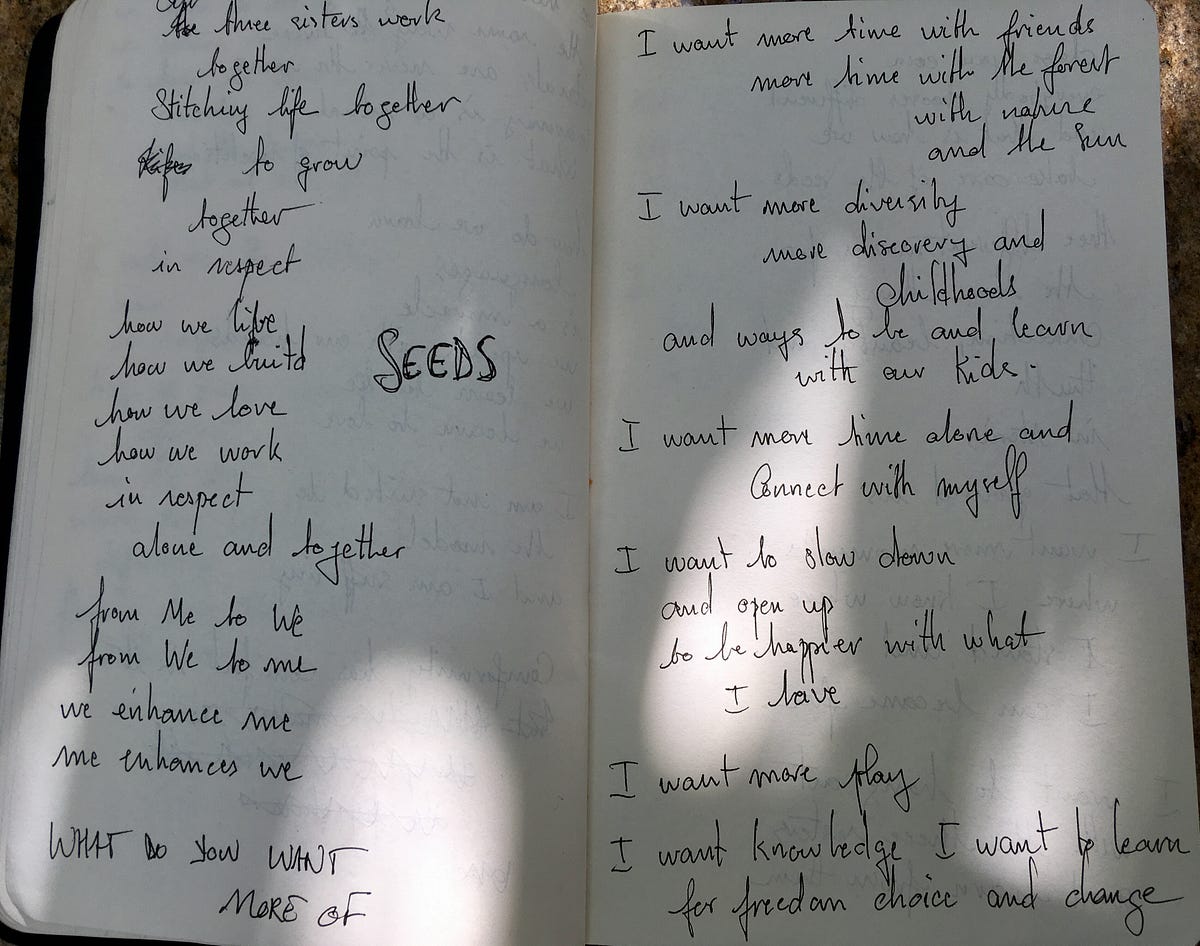
Tionnhehkwen: Seeds of life


Native Immigrant is a community arts project stewarded from Montreal by Carolina Echeverria. Its intention is to bridge Native peoples and Immigrants through a variety of cultural events.

The collective of Native-Immigrant came to be in 2016. It is a diverse group of individuals that believes that culture should be something alive and organic. The main activity of Native-Immigrant is the construction of dresses. Each dress collects objects that tell the story of who we really are.

In June 2017, Native Immigrant organized its 7th event, called Tionnhehkwen: Seeds of Life. The event was an expression of our wish to reconnect with food and the land, and all other forms of nourishment, be it physical, mental, spiritual or emotional.

On this occasion, I attended a Conversational Circle : Creation Story Unmasked, led by Mohawk cultural interpreter and educator Oskenontona Philip Deering.

I harvested the words and stories that flowed in the circle and the following poem weaved itself on the page in front of me.

We are all the same height

the idea of happiness

nests in the heart of the teacher

the children laugh

the children learn

the children love

how humans speak

how humans learn


knowledge is a verb

knowledge has will

knowledge is understood

many times over

knowledge is maybes

knowledge may be


we are all the same height

and we can decide

what we learn together

I know of a place

where miracles happened

when we gave an ear

to what wanted to happen

she had a bright appearance

on her face

she was transformed

and yet they all knew

we were all transformed

humans fail

humans learn

humans choose

humans create themselves

humans learn to cherish

the world

humans learn to cherish themselves

humans learn to become

humans

we are we

because I am one

I am one in we

we are strong

because me is strong


we are all the same height

twins who live differently

and are respected individually

we are all the same height

and this is how we live

and this is how we learn

and this is how we love


the faces of children

those not yet born

come from the earth

we throw the weapons of war

in the sky

where they can be lost and forgotten

we turn to the earth

we return to the earth

to hear the voices of the not yet born

to hear the voices of the ancestors


I could see the children

learn

in happiness

learn to be happy

learn from happiness

they all knew something

different

than the others

something which

they learned differently

flowing from the culture

and the stories

of creation

and we can all learn from that

to be better learners

and become better humans

rituals are never lived

the same way twice

learning is a ritual

that repeats itself

but is never the same

we are all the same height

we learn languages

and perform miracles

we speak with our hands

we learn to lie

we learn to love


our three sisters work together

they stitch lives together

to grow

together

in respect

and in trust

that the seeds will come


we are all the same height

and this is how we live

and this is how we love

and this is how we build

and this is how we work

in respect

alone and

together

from me to we

from we to me

we enhance me

me enhances we

we are all the same height


I want

more time with friends

more time with the forest

more time with nature

more time with the sun

I want more discovery

and more childhoods

and ways to be and

learn together

I want more time alone

I want to slow down and

open up

to be happier with

what I have

I want more play

I want to knowledge

for freedom

for choice

for change

I want to see

everybody choose the corn they want

because that how we take care of the seeds

I want to hear

I want to see

I want to feel

connection beauty and truth

in the stories that ground us

I want more moments

where I know where I stand and

I can become free

I want to hang out with the three sisters

and make rhizomes

and contribute

consciously

to the organisms


I want to care

for the ear that receives and

for the mouth that shapes

the story

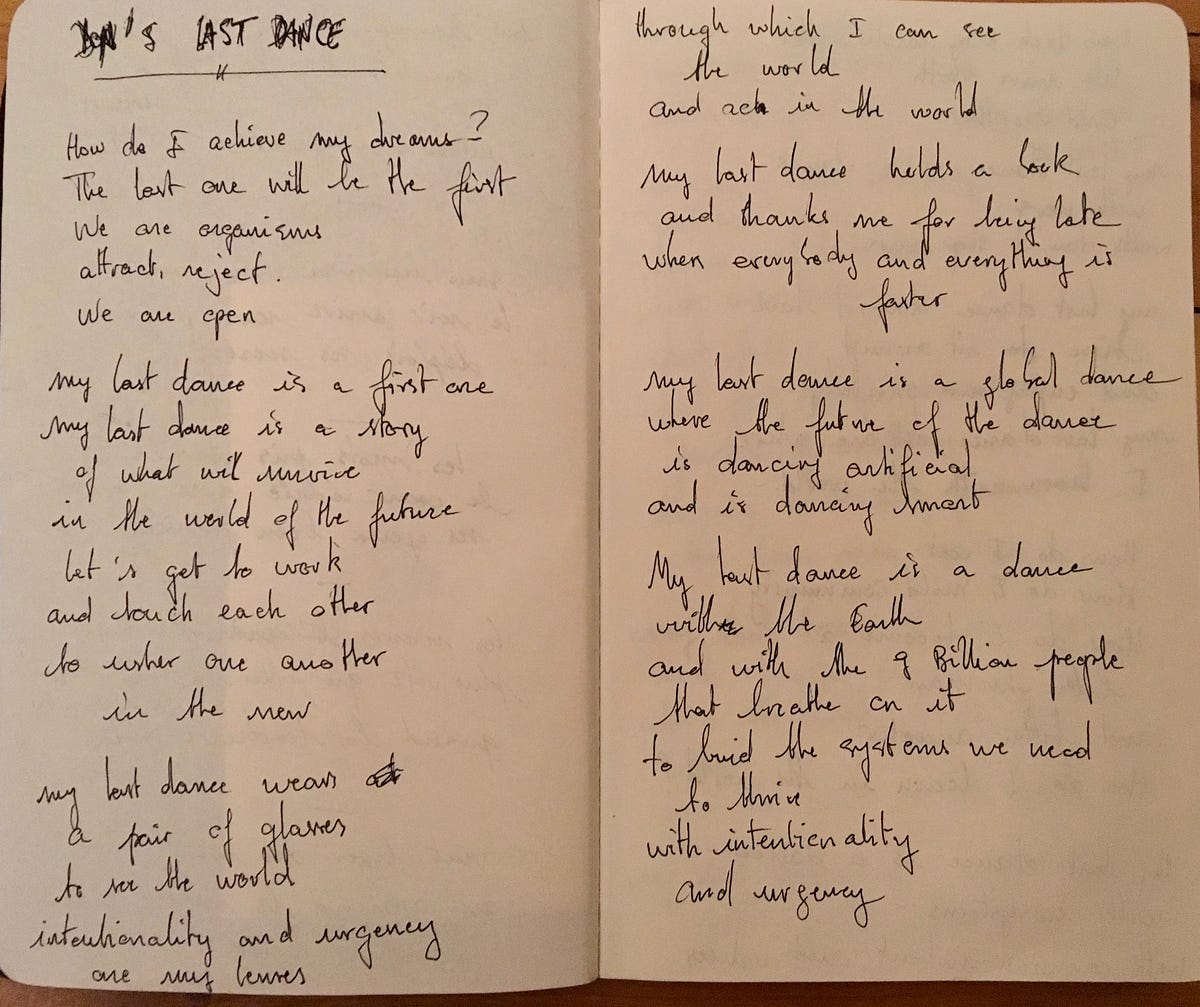
Don’s Last Dance (Tribute to Don de Guerre)


For the last decades, Don de Guerre has been a mentor for hundreds of students and aspiring contributors to the change community in Montreal, Canada and the World. His ideal of a more democratic, open, caring society, his relentless faith in human beings, and his commitment to building a better world and becoming a better person have inspired and moved people. I am one of these people. On May the 26th, 2017, Don gave to his students and friends his “last lecture”, as he is leaving Concordia University. It was an opportunity for him to share his views of the world, the future and the work that needs to be done. As a token of appreciation for a man who has contributed a lot to my thinking, while he was giving his lecture I harvested the words and images that flowed in the room. What follows is what I read to him in the aftermath, to thank him for the wisdom and the joy he so generously shared with us over the years.

How do I act my dreams?

What will the last dance say?

The last dance will be the first dance

An organism

Attract, reject

An open dance

My last dance is a first dance

My last dance is a story

Of what will be

In the world of the future

Of getting to work and

Touch each other

And usher each other

Into the now

My last dance wears a pair of glasses

To see the world

Intentionality and

Urgency

Are the lenses

Through which I can see

And act

In the world

My last dance holds a book

That thanks me for being late

When everybody

When everything

Gets faster

My last dance

Is a global dance

Where the future of the dance

is dancing artificial

And dancing smart

My last dance is a final dance

Is a first dance with the earth

And with the 9 billion people

That will breathe on it

To build the life we need

To support Life

My last dance is a dance with wars

And with the walls that will not stop them

My last dance does not have time

To sit around

While I enjoy my privilege

My last dance is one where I learn with the world

To act wisely

And build community

And learn to become

A better ancestor

And a better human

My last dance is a first dance

A dance with ecosystems

With values

To move together, at last

And do good work

Let’s do good

work

And trust each other that we can do it

My last dance is a dance

Where the whole is in the parts

And the parts are in the whole

And I am dancing with gentle action

And fast failures

That may help us survive

And search for depth and meaning

My last dance is our dance

Creating a loving, caring community

And do it more

And do it better

And our last dance

Is improvised

With you

With me

With we

With yes

With appreciation

With love

With grace

With you

With us

With the world

With life

With what there is

With what may be

With what is uncertain

With creativity

With the the other

And in our last dance

We got this

Together

We got this

My last dance

Is my first dance

Is our first dance

And I am here with my friends

I am your friend

Poetry is hosting and harvesting humanness

Nowadays I find myself living in two questions, both in my work and in my life: 1) What is hosting? and 2) How can we host from the rim of a circle?

I recently happened to join a group that was gathered in Ottawa to design a new conversation model that can engage all Canadians — in response to the divisive, polarizing attitudes that appear to be trending in the US and Europe. As we first came together, not knowing each other, we started with a check-in, putting in the center of the room the thoughts, stories, experiences that led us to be together in this place and at that time. The question that was asked was simple and powerful : what’s on your shoulders?

As people started to share, a collective story started to emerge, through the weaving of individual experiences : thus creating the soil for an experience of belonging that could lead to the collective work that needed to happen. Words were spoken that told stories of loss, violence, displacement, belonging, hope, reconciliation, grief, love, and agency. It was emotional, raw and beautiful. You could feel in the room the importance of the moment. People stripped themselves of their layer of professionalism and competence, and showed up as humans who were invested in doing good work to create a better world.

In those moments, good harvesting is an act of love and service to the group. It can help a group amplify and make sense immediately of its collective voice beyond all these individual stories. There are many ways to do this. In Percolab, my colleague Paul uses his talent to create visuals that convey those stories and harvest those insights. Poetry can have the same powerful impact, and help host a group by staying present to all stories that are shared.

Listening for patterns is what informs us on who we are, and who can be collectively. I tune my ear to the question that is asked. As the poem takes shape I become able to see associations, relationships that are forming between people who do not yet know each other. I can enter a space where I am in service of this collective that is emerging. The ego starts to dissolve, but the warrior for what is important comes into focus, at the same time as the collective story. There is no need to edit, just to listen and play: if this is to be a reflection of the humanness of this community it will be partial and imperfect. If it is in flow it will retain the islands of meaning and collective strengths within the complexity.

Here is an extract of what came out of this process:

on our shoulders

is our father’s boat

on our shoulders

are bridges and boats that are not build yet

on our shoulders

is the responsibility to be

better ancestors

and better descendants

on our shoulders

is our need to learn, care, connect

and tap into the wisdom

of doing without knowing

on our shoulders

are our lives of priviledges

on our shoulders

are our lives of oppressing

and of being oppressed

and of being afraid

on our shoulders

is the need to celebrate and hold curiosity

fiercely

and with humility

learn to be with what is needed now

burst our bubbles

with kindness and humility

and grace

on our shoulders

are the curtains that have been pulled

from our eyes

and a world that is not what we thought it was

and the need to see

on our shoulders

is the need for a tower

to find the 100 pairs of eyes

that will help us see the world

What becomes important at that moment is that it is shared in the circle, as is, without filter. As a pure offering, a mirroring of what is there, giving an image of who we are through the woven words and stories that have been shared and put in the collective center. The poem in that moment if the first artefact of a commons held by the emerging community. Our role as hosts and spaceholders is to give « it », what wants to be born, a tangible shape, or form, be it through poems, visuals, or any other mean. It might be early, imperfect, a little dirty, a little raw, a little noisy, but it needs to be there in that moment for what it can then make space for : becoming a community anchored in something bigger than ourselves.

That early harvest is important work, as it can then be a difference between a group that stays focused on its purpose and a collective that falls in the trap of arguing about philosophical differences. What this experience helped me realize is how Hosting and Harvesting are really two sides of the same coin. If hosting is the art of creating and holding containers, harvesting is listening for the insights that help our groups make sense of their collective experience in those containers. My experience of Slamming as a harvest practice is one where poetry comes in service of a collective to help us surface our collective voice, make sense of the work we do and create more intentionality and presence to one another.