I have been sitting in a space of uncertainty for a few months. I have been sitting with a simple question: what am I doing? It does not always feel good, but I think it is ultimately a good thing. I have been doing this work of systems change, or human systems interventions, or hosting, or teaching (sometimes all at the same time) for more or less 20 years now, and lately there has been a melancholy, a tenderness and a tiredness to it. Listening, trying to make sense of what it means today, here, and now, there may be a sense that as the world is changing, so does my purpose. What feels good about this is that it reads like a sign that I am growing out of a comfort zone, into something that might create new possibilities.
I remain convinced that several things hold true in this world and in this work. Here are some of them:
- We need each other, and therefore we need to get better at inviting, and at recognizing invitations.
- No one is smart enough to lead alone through the crisis of our times. We just can’t know everything we need to know.
- We all need to get better at learning and listening (to one another, to the world, to time, to ourselves).
- Working with others who are different than us is challenging, and we need to build our capacity to do just that. That means stepping in to work with others who don’t think, learn or act like us.
- We are the systems we live in. The systems we live in shape us. We cannot change the systems that shape our lives without changing ourselves. We cannot change ourselves without changing the systems.
- We need to become better at noticing how we participate to and benefit from systems that oppress and marginalize. We also need to recognize that noticing is not enough. What becomes possible when we learn to creatively and critically engage with these systems?
- Human systems (institutions, organizations, etc.) are built by humans. They can be changed by humans.
- The human systems we have built do not work for the vast majority of us. We need to change them, or build new ones that will work for us.
- The outcomes of a system are its purpose. Therefore if a system produces exclusion and poverty, that is what it is meant to produce. Therefore, to change the outcomes of a system, we need to change the system. To change the systems we live in, we need to change ourselves too.
- Change is fractal. It emerges everywhere, touches everything, happens all at once.
- Changing is dying a little bit. Therefore, to do the work of systems change we need an increased capacity for holding grief.
- In some ways, we all already know how to do this. When push comes to shove, we have always known. Our work as hosts (and teachers) is a lot of reminding each other what we already know, in our bones.
- We need to stay humble AND We also need to learn how to consciously use the power we do have.
- We won’t plan and control our way out of this.
- The seeds of what is needed to change are already present.
- All good revolutions need campfires. EWe need to learn to build good fires, and to tend to them well.
There are more, of course!
What are the skills we need to be good helpers, in a world where we hold these things to be true? What does helping mean, in this context? What does it mean to help systems change? What do we need to (un)learn? How do we need to practice? What do we need to practice? How and where do we (un)learn this?
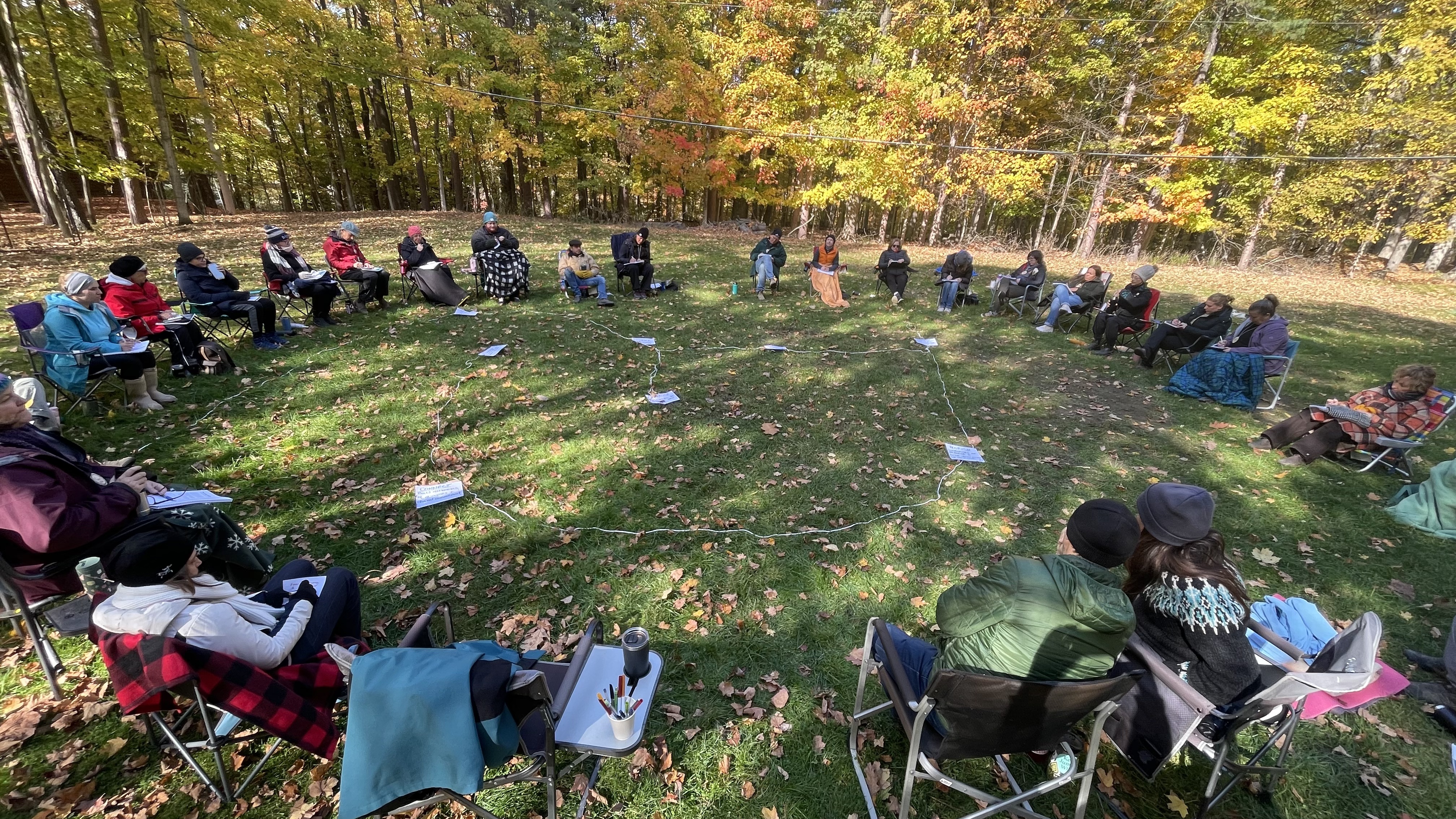
It takes spaces to practice, be in dialogue, learn to (un)learn from one another and from the world that is surrounding us. That, to me, is what education should be about. And there are practices we can explore to foster these spaces, infuse them with more life, and build more community while we are at it. This is what we are trying to create and offer with Reimagining Education: a three day Art of Hosting training, and a time and place to experiment with new (and old!) ways of creating experiences where people can learn and be in community.
This is what we have been stewarding together for 4 years now, and one of my very favourite places to learn and practice. For four years, I have been blessed to work and play with good friends and inspiring practitioners, and to meet people coming from a wide diversity of cultures and practice fields. Together we create a deep field of inquiry around education, learning and how systems change. Wherever you are in the education systems, you will find something to offer and something you need in this conversation: if you are a student teacher thinking about how you may teach students who will be becoming adults in a world radically different from the one you grew up in. If you are a school administrator who wants to see systems where no one gets left behind and everyone can be their full selves. If you are a parent who wants to see their child flourish and develop their agency in the world. Or if you want to help workplaces develop systems so that everybody can learn and be the best version of themselves. You are invited to bring your questions, your longings, your dreams, your dilemmas. You are invited to bring your projects and your work.
We are a team of 4, practicing from different places in the world of learning. Jenn Williams is a self-described teacher gone rogue, who has been experimenting her way of through how to set up learning spaces across worldviews, cultures and environments, tearing down the walls of the traditional classrooms to build new bridges where people can unlearn and relearn who they are and what they can be together. Troy Maracle has been a leading force behind the resurgence of Indigenous Education in Southern Ontario for more than 30 years. As a proud Kenhté:ke Kanyen’kehá:ka he carries the teachings and practices of his culture in all the learning spaces he holds, including this one. Chris Corrigan has been stewarding the practices and the learning community that is the Art of Hosting and Participatory Leadership, always pushing the boundaries of what is possible to achieve with these practices and sharing generously the lessons he is learning and the questions he is exploring in his extraordinary blog. For four years, he has been offering the gifts of many conversations he has been in throughout the years to this particular experience that is Reimagining Education. Our fifth and most important team member in this is the Land we will gather on and learn with: the Camp Kawartha Environment Centre , located in Peterborough, next to Trent University’s stunning Wildlife Sanctuary lands.
We all have a stake in reimagining how we help people (and ourselves!) learn. We all have our different entry points in this inquiry. So – if, like us, you are curious about how to foster learning spaces that are more inclusive and just, where the beauty of our human potential can flourish, where we can all practice the tricky art of being in community and co-creating together the world and the systems we need, come learn with us. That’s what we are here for.
Come explore with us: what grows when we courageously imagine the future of education and learning together?
You will leave from these three days with concrete tools, frameworks, methodologies to foster more engaging spaces. But you will also likely leave with some more things, more elusive, unpredictable and untangible: unexpected wisdom, a sense of belonging to a learning community, new allies in your work, new ideas, new clarity (or maybe more of the “good” confusion!). And overall, we hope you will leave with a sense that there are more of us than you thought, who are engaged in this work for the long run, and that there are more possibilities than you thought.
This is the power of what Margaret Wheatley calls Islands of Sanity. What we are inviting you into is one such island, where you get to reflect on your work and explore your questions with others, only to leave with increased power and clarity to tackle the work that is yours to do. And as I loop back to where I started this post, with the sense of uncertainty, discomfort and unsettling, I realize that this invitation is my way of offering what I need: a place and time to lay down my weapons of love, look back at the practices that have supported me and build more capacity for shared inquiry around how we shift to systems that elevate our collective creativity and agency.
This year we’re at Camp Kawartha’s beautiful Environment Centre in Peterborough, Oct 16-18th.
Registration is open and I am so excited to discover what we will co-create together.

