
Some reflections on the Art of Hosting and Reimagining Education
« to innovate or understand
to work with human complexity
with problems that are not clouds and not clocks
we need people and
inquiry
creative diversity
to act and respond
with creative possibilities
we need learning
insights
connections
new ways of
seeing and acting emerge.«
On October 19, 2023, we gathered on the shores of Lake Opinicon. 33 humans sharing a space for three days. A joyful hosting team: Jenn Williams, Chris Corrigan, Troy Maracle and me. We came from different paths of life, different communities, different worlds. Educators, administrators, facilitators. Parents, community leaders, activists and thinkers. Innovators and stewards of systems. Indigenous People, immigrants, settlers. Mothers and daughters. Brothers and cousins. All called around this question of ‘what becomes possible when we courageously reimagine education?’ All called to learn together how the Art of Hosting could help us spark our collective muscle of imagination. All called to practice participating and inviting the conversations that will infuse our work with purpose and kindness, to usher the world we want to see our great grandchildren growing in. Bundled in the same dish, we stepped in the circle, curious to harvest what we did not know could feed us.
« dee Hock calls
the “Chaordic” path of
a creative tension between
“chaos” and “order”
it is the place of generative
emergence«

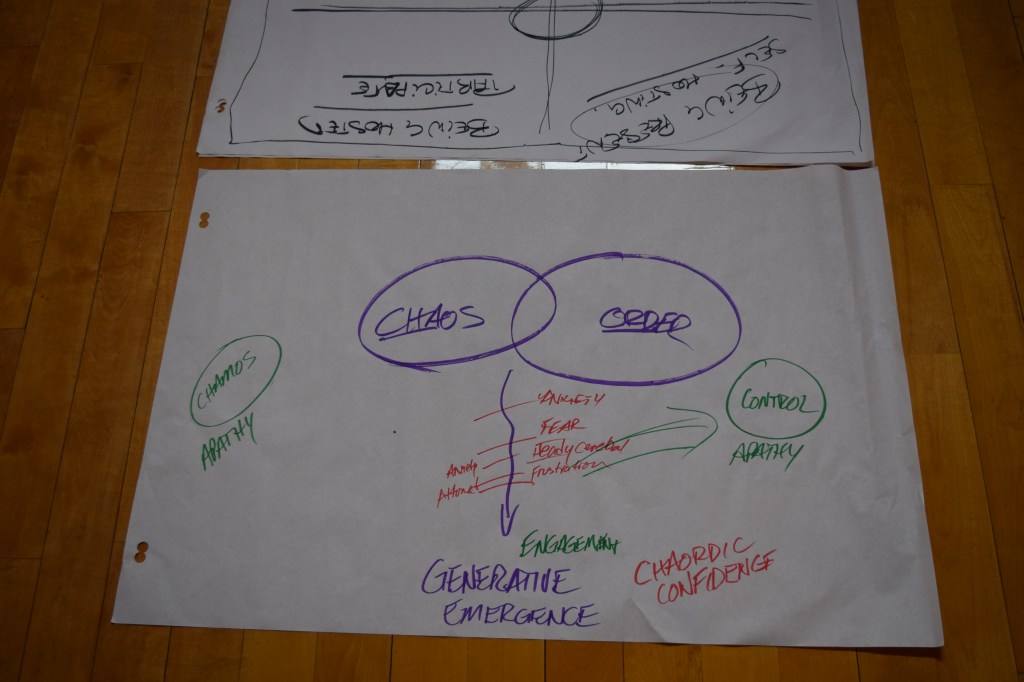
Here, hosted by the beautiful nest of nature surrounding us, by the forest, the deers, the fungi and the lake, we played in the liminal space between chaos and order. We breathed between structuring a container with some just clear enough governing principles: ask for what you need, offer what you can. Listen with curiosity. Speak with Intention. Share your truth. Be aware of your impact. Harvest your conversations. Take responsibility for your experience. These principles provided grounding and a clear landscape to exist in, and invite a water-like quality of questions, uncertainty and creativity to infuse and circulate between us. Generative emergence is that space of possibility, where we are neither too constrained by structures nor are we thrown in so much uncertainty and ambiguity that we can just react. It is that space where we can act with intention, without being constrained by what has been inherited from the past, resorting to what has already been done. Where we have the freedom to invent our best practices, aligned with the specific context we are in.
« think leadership
and
process design
with complex problems
when wanting new ideas.
what helps us
when we are stuck?«
How we practice in the chaordic space in the context of a 3-day art of hosting training is by creating a rough architecture of a schedule, put the bones in place, While leaving enough space to listen, regularly check-in with our perceptions as hosts, what we hear from the community, and adapt to the feedback we are receiving. Do we need more time for certain pieces? What questions are alive in the community? What are some pieces we need to bring in, what are some that could be tended to by exploring them in a community dialogue? Where are people at, and do we need to bring in new ingredients or approaches to tend to the space that we are holding together; for instance, maybe we have been spending a lot of time in our heads, processing, and there is a need to get on our feet and do something that calls on different parts of our selves, that get us moving and laughing, and trying things we do not normally try..
« Living systems
order and chaos
each purpose together
holding potential
a creative tension
and space
where engagement and creativity
happen
generative emergence.
Dialogue in this space
opens complex possibilities.«
As a community, we tend to be pulled in different directions. We need both chaos and order. But we may also have personal preferences that lead us towards one polarity or the other. Some of us get uncomfortable with the uncertainty and the ambiguity that chaos invites in. In these times, they might look for the stability of authority and clear leadership. This is the area of plans, timelines, linearity, structures. Yet others may feel constrained by too much control and look to invite the openness, creativity and sense of possibility that chaos carries. As we create community together and learn to care for a common concern or purpose, we lean on both polarities. We invite order, and we invite chaos. We try to dance with both partners, and trace a liminal space of practice in the middle, where we are never completely one and never completely the other. As a living system, we move with the change, leaning on the diversity of our parts to maintain our balance and move through the world with grace. Purpose is our compass: the communities we are here to serve, the work we are here to do. In our dance, we trace our path to host the next generations in a world in which they can live and thrive.
« There are moments
stable and
predictable and
other times
surprising, wild, unpredictable, or out of control.
leadership
is the art of coping
with the swings
from chaos to order
and of working in the
intersection »
What do we do when we don’t know what to do? What do we do when what we thought we knew is no longer the only way, or the best way? Chaordic leadership is the practice of staying true and staying in relationship with one another in these times. Not veering too much towards chaos, and throwing all structure to the winds, compromising our values and our beliefs in favour of whatever the tide contains, nor bringing too much order, control authority to set the situation back to a normal that never really existed in the first place. What is our response in the face of uncertainty?
« Life throws
our best plans
we strive to
bring enough form and structure
life-giving contexts for
action,
stability and
structure to express and
bring talent and capacity to work.«
Chaordic competence is about bringing just enough form and structure to allow creativity to thrive. There is movement, but we are not swept. There is structure and constraints, but we are not pinned down by it. There is stability that gives enough space for people to bring and give their gifts, be in their whole human potential and grow new capacities. There is space and permanent change there. The chaordic path is a dance. The structures that create space for emergence evolve with the context, and so we cannot rely on firm rules, but on principles that help us read the context, govern our actions and stay in the chaordic space. These principles are value based and can look different in action when in different circumstances. They give us tools to recognize when we are moving away from the chaordic path. When do we start to use the language of control and coercion? When do we create policies and structures that risk removing people’s agency and, in a way, tame them by telling them what to do?

« too tight, and we need a little more chaos.
a loosening of rules
and control
power shared
more space for people to take
more space for diversity
more space for self-organization
new connections
to be seen or made. »
There are a few different ways we let a bit of chaos in during our recent Art of Hosting. The first one that comes to mind was an intentional move to be hosted in a site deeply connected with nature. We were in a forest, with access to water and trails and ample space to breathe. We were able to create multiple moments to go out on the land, sometimes to hear stories, connect with one another or to try to listen deeply to what this natural house asked us to pay attention to. We were influenced by the weather, as the rain came to remind us that staying put or staying out was a choice, and that the world was still knocking at our door while we were having our conversations. We invited initiatives and offers from participants to host experiences and shape with us how we organized our time together. We leaned on our seed sanctuary of living questions harvested by the participants to shape our own offerings, in the form of teachings or stories. We held a dialogic container structured with a very diverse set of participants, and multiple opportunities to connect with different people around joined inquiry. We invited people to host the conversations and experiences they decided they needed to have, to experience what it could be or feel like to invite others in this way.
« too loose and we need more order
to stabilize situations
invite more certainty and predictability,
move towards decisions
efficiency.
rules, directions, accountability
power, control and decision more centralized
time, focus, sharing are more constrained
for work that needs efficiency
for times where we know what to do. «
There are also a few different ways we invited structure and order into our shared time. There was an invitation. There was a schedule, structured around some clear constraints. There was an identifiable, clear hosting team that framed and held space, while also maintaining a collaborative relationship with the site team who was hosting us. There were leading questions. There were clear meal times, with special procedures in place to keep everybody safe, including those of us who suffer from allergies. For each block of time there was a clear harvest, with artefacts that were accessible to all. There was a seed sanctuary, a clear place in the common space whose purpose was to keep track of emerging and living questions and concerns in the community we had become. And there were some common assumptions: that we can all learn and lead chief among them.
« Leadership is discernment
include ‘chaos’ and ‘order’
to create the life giving contexts
that lead to emergent outcomes. «
That is the dance of the Art of Hosting: keeping enough order that some sense can be appropriated and that some experience of belonging can happen. Enough order that an atmosphere is fostered with enough psychological safety that people can take risks and try new things and be a bit uncomfortable. Enough chaos that people might feel invited out of their comfort zones. Enough chaos to invite differences and diversity, but enough order to have coherence. Enough structure to give a recognizable shape, and enough chaos to invite change. Leading is recognizing the signs when one of these two might be in need… It is, in a way, asking what life needs to thrive in the moment, and acting on that inquiry. Sometimes acting might be a change in process, a break, a question, a new invitation, a guest… Sometimes what might be needed is naming my confusion, or my intuition, or my discomfort, and sharing with the group that I am not confident that we are doing the right thing and that I don’t really know what to do. And asking the community for help to figure this out. That can be a graceful use of my power as a host.
And what do we need in order to practice this dance with chaordic confidence?
- Tools – We need to know some moves: have a set of tools, methods, frameworks to mobilize and choose from. A whole library of them, I would say. Become a researcher, an experimenter, an expert. Look for the things that work.
- Context – We need to know the context in which we are operating. We need to know our communities, the people we are living and working with. And we need to know how to be curious about the people who are not the people we live and work with. What do they need? What do they want? How is it like to be them? And if we don’t know, we need to know how to ask questions, and build relationships.
- Self Hosting – We need to know that we can stay present. And that only happens through practice. Through practice, we learn what it is that takes us in and out of that ability to be present. We learn to read these signs that tell us we are working out of alignment with ourselves and our values as a community. Through practice we learn to trust that a way can be found though curiosity in community.
Curious for more? Here are more resources on the Chaordic Path:
- Here is a beautiful video produced by the Bush Foundation, in collaboration with the Art of Hosting community
- From Caitlin Frost – Engaged Leadership: The Chaordic Path
- From Chris Corrigan – The Chaordic stepping stones, a helpful design tool to work in complexity
- From Kathy Jourdain – The Chaordic Path: The Dynamic Inter-relationship between Chaos and Order
All quotes from this post have been adapted through an extensive (and playful!) cutting up and remixing process from « Engaged leadership and the chaordic path », in The Art of Hosting Conversations That Matter – What Grows When We Courageously Imagine The Future Of Education And Learning Together? (Harvest Moon), our workbook for this recent Art of Hosting and reimagining education.
With deep gratitude and love to my amazing team of co-hosts who held space for the magic to happen: Jenn Williams, Chris Corrigan, Troy Maracle.
 ici - ailleurs