A community spice garden, a take-a-book, leave-a-book library, or a samosa stand. Many people have a project or an activity that would make their city better. 100 in 1 day brings all of these together. 100 in 1 day is an event co-created by La MIS, City of Montreal and the Institute du Nouveau Monde. La MIS is a McConnell partner and Cities for People is proud to share learnings from last year’s 100-in-1-day as we look forward to 100 in 1 day 2019.
What is 100in1day?
The idea is simple: it stands for 100 actions by regular citizens, like you and me, to create the city of our dreams.
Why all the same day? So that all intervention leaders can feel the presence of all the other city lovers with them on that day, experience being part of a community of transformation and feel the power of numbers. In this day we are all together, engaged in what has sometimes been called a “festival of doing”. From coast to coast, hundreds of residents set to take action to make their cities better. In 2018, almost 800 interventions took place across the country.
100in1day is a prototype of a city that is made by its citizens. It is a practice of stewardship for all of us to re-learn to consciously inhabit the city in a spirit of celebration. These actions can take the shape of a community clean-up, a workshop to crowdsource solutions to big or small issues affecting a neighbourhood, a curated walk to explore the imaginary possibilities of a public space, a clothing swap, or a workshop to write a postcard to welcome a refugee. It can be anything you want, wherever you want it, for as long as you want, as long as it is rooted in a deep sense of care and imagination of a city as a place where life and people can thrive.
City-making as re-connecting
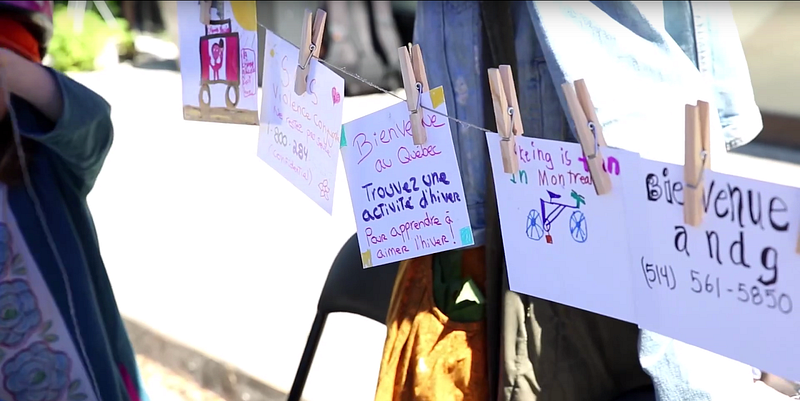
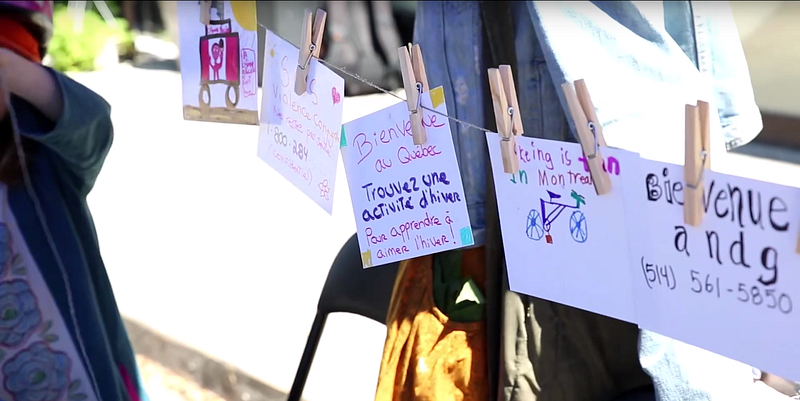
We are standing on a sidewalk at the corner of Sherbrooke and Beaconsfield in Montreal. A group is sitting around a table under a tent with arts and crafts material. They are crafting postcards to welcome newly arrived immigrants and refugees. Smiles abound. Conversations are alive. Children are running around. Hilarity ensues. Each postcard holds a piece of advice, or something that they would have liked to know when they themselves first came here. Care is flowing from one human to another. Newcomers and welcomers feel seen and valued.
We are in a church in Little Burgundy. A group of people is sharing bread. All kinds of bread, from many different cultures. Round, long, flat, and even fluffy breads. They are all seen, and welcome, and tasted. Bread carries stories. How these different breads got to be laid on the same table, in a Montreal church, is nothing short of a miracle. It hints at something deeply ingrained in the daily fabric of this city. As a Haudenosaunee elder from Kahnawake once told me : « we are all the same height ».

These projects are all part of the 100in1day interventions that tell stories about the city people aspire to live in. Looking at these actions, we can see a desire for generative intercultural exchange. A place where people can find multiple opportunities to interact across cultures.
A wide diversity of cultures coexist in Montreal, shaping the social fabric of the city. Wave after wave of immigrants have made the city what it is today. In 2013, Montreal was still home to more than 85 % of all immigrants living in Quebec, according to the Bulletin of the Metropolitan Community of Montreal. Diversity has become a key feature of the identity of the city and a source of pride for Montrealers.
And yet the power of 100in1day is often to point out gaps that citizens want to fill, while providing examples of how to fill them. These initiatives point to a lack of formal and informal spaces for dialogue between cultures and people.
Citizens who already connected with newcomers and the city’s different cultures and communities might not feel the need to independently organize events to strengthen these connections. These initiatives suggest that even though Montrealers advertise a love of diversity, the city is also sometimes fragmented and disconnected. Perhaps the city is not as open as the prevailing narrative around diversity would seem to indicate.
It highlights a tension between what Montrealers embrace as a collective value (inclusion and an appreciation for diversity) and what is really going on in public space (a fragmentation of communities). It is a creative tension, because it has the potential to move people who hold that aspiring narrative as a core value into creative thinking and action.
100in1day asks the question, what would we need to do to create the city you want to live in? The answers to this question are everywhere in 100in1day, as regular citizens get to design these small interventions that work as prototypes of the city they want. Through their creative actions on that day, they manage to name the world they want and take a first step towards living in the story they aspire to.
Building the city as a commons requires that we develop practices to care for it collectively, which cannot happen without strong communities defined by collective belonging. This requires a tricky dance of strengthening shared identities without devaluing one’s own specific culture.
Going deeper
These snapshots of Montrealers welcoming newcomers or sharing bread together, point to a vision of a future Montreal where diversity is intimately woven into everyday life. Each of the projects creates a shared moment between people who come from different horizons and share the same space. They involve citizens that step up and prototype ideas that fill a need that they see and an aspiration they have towards inclusion and wholeness.
Citizen led projects involve deeper processes of civic-engagement and co-creation than most city-building projects. They are an opportunity for people to meet and include others where they are, see the value of their experience and recognize their right to thrive in the city. It requires curiosity and openness to different realities and experiences. It also requires us to be able to tell our story and own our own experience.
We cannot be naive, and just assume that because the actions are designed and led by citizens, anybody can do it. We need to acknowledge that the people who participate in these spaces tend to be people who already benefit from a wider sense of agency and tend to already have access to participation spaces.
That, in itself, is part of what we collectively need to heal. 100in1day is a step towards engaging with people who are different from us, and repairing some of the fragmentation between us and within ourselves. It is not the endgame. But while we should stay honest about the outcomes, we can also celebrate the fact that people are making that first step for themselves towards developing stronger relationships with others, even if it is just a one-day experiment.
Experiments and processes in collective imagination such as 100in1day show that we want and need to engage with difference and we may have some fun along the way, and find out that practicing love is a pretty good design principle when it comes to building strong communities that serve life.
 ici - ailleurs